
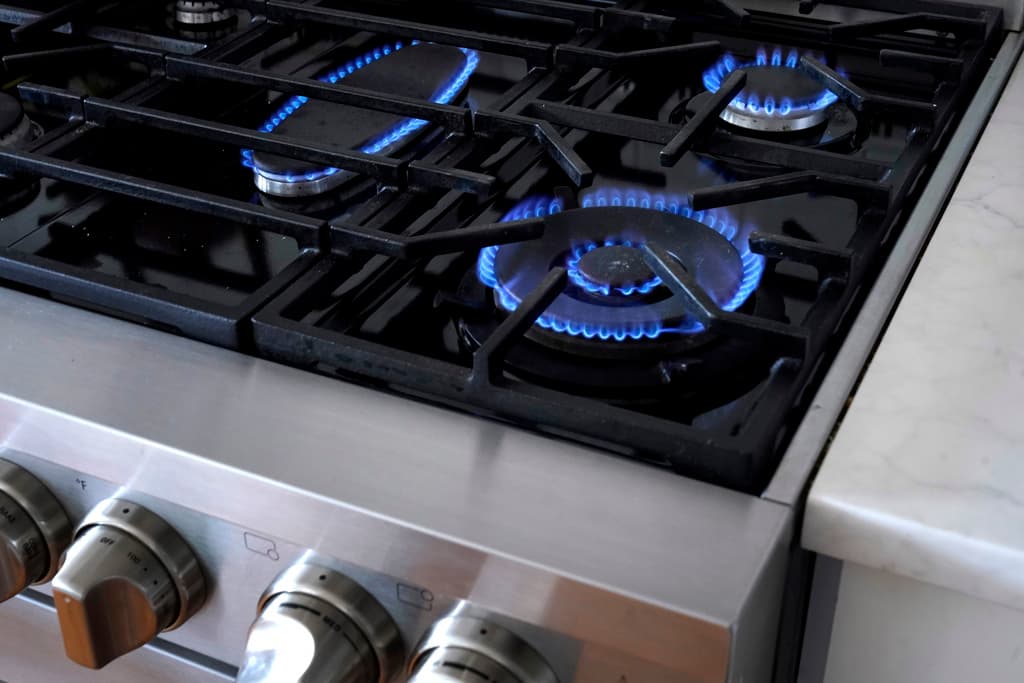
A federal judge has partially dismissed a lawsuit challenging the state of Colorado for its new gas stove law, which requires retailers to display cigarette-style health warning labels on the stoves in English and Spanish.
The first-in-the-nation state law took effect in August and was immediately challenged in court by the Association of Home Appliance Manufacturers, which claimed it violated the First Amendment by forcing manufacturers and retailers to direct consumers to “misleading” information about health risks linked to gas stoves.
The new law comes amid a nationwide debate over the health risks of indoor cooking. Health advocates point to mounting research showing gas stoves are a harmful source of dangerous pollutants like nitrogen oxides, which have been linked to asthma and other health issues. Meanwhile, the natural gas industry claims the science is unclear, and it’s argued attempts to regulate gas stoves are climate policies disguised as public health initiatives.
Colorado passed its labeling law after similar legislation failed in other states. Signed by Gov. Jared Polis in May, it requires gas stove sellers to apply a yellow sticker reading "understand the air quality implications of having an indoor gas stove,” and a URL or QR code to a state webpage with information about the risks associated with the appliances.
The appliance manufacturers claimed the law violated their free speech rights by forcing them to suggest there's a "scientific consensus” regarding health threats posed by gas stoves. In a November 25 ruling, United States District Judge S. Kato Crews partially dismissed the suit, ruling state health officials have a basic right to publish and maintain a website under the 11th Amendment.
The judge ruled the plaintiffs incorrectly suggested specific health officials have the authority to enforce the law. The suit named Jeff Lawrence, director of the Division of Environmental Health and Sustainability at the Colorado Department of Public Health and Environment, and CDPHE’s Executive Director Jill Hunsaker Ryan. In the decision, Crews concludes Ryan and Lawrence were incorrectly named, and that the role of enforcing the law falls to the Colorado Attorney General Phil Weiser, who appliance retailers acknowledge can implement state laws.
“Retailers have a duty under the Act to include the label and QR code on the gas-fueled stoves they sell in Colorado, while the CDPHE Defendants only have the ministerial role of creating the website that the label itself directs consumers to,” Crews wrote in the decision.
Since the law doesn’t require state health officials or the attorney general to exceed their constitutional authority, the judge partially dismissed the case last week. Attorney General Weiser’s office declined to comment on the lawsuit Thursday since it’s still pending.
Chris Doscher, director of communications for the Association of Home Appliance Manufacturers, said in an email: “We are disappointed with the judge’s decision. However, this decision does not affect our case against the state of Colorado, and it does not change the essential nature of the case, which is to prohibit the state from enforcing this unconstitutional labeling law.”
- Gas stove makers quietly delete air pollution warnings as they fight mandatory health labels
- Colorado is the first state to require cigarette-style health warnings on gas stoves. It’s already facing a lawsuit
- Denver has a plan to push natural gas out of buildings. Restaurant, hotel, building and propane groups have sued to stop it
- The behind-the-scenes plan to protect natural gas stoves and furnaces in Colorado