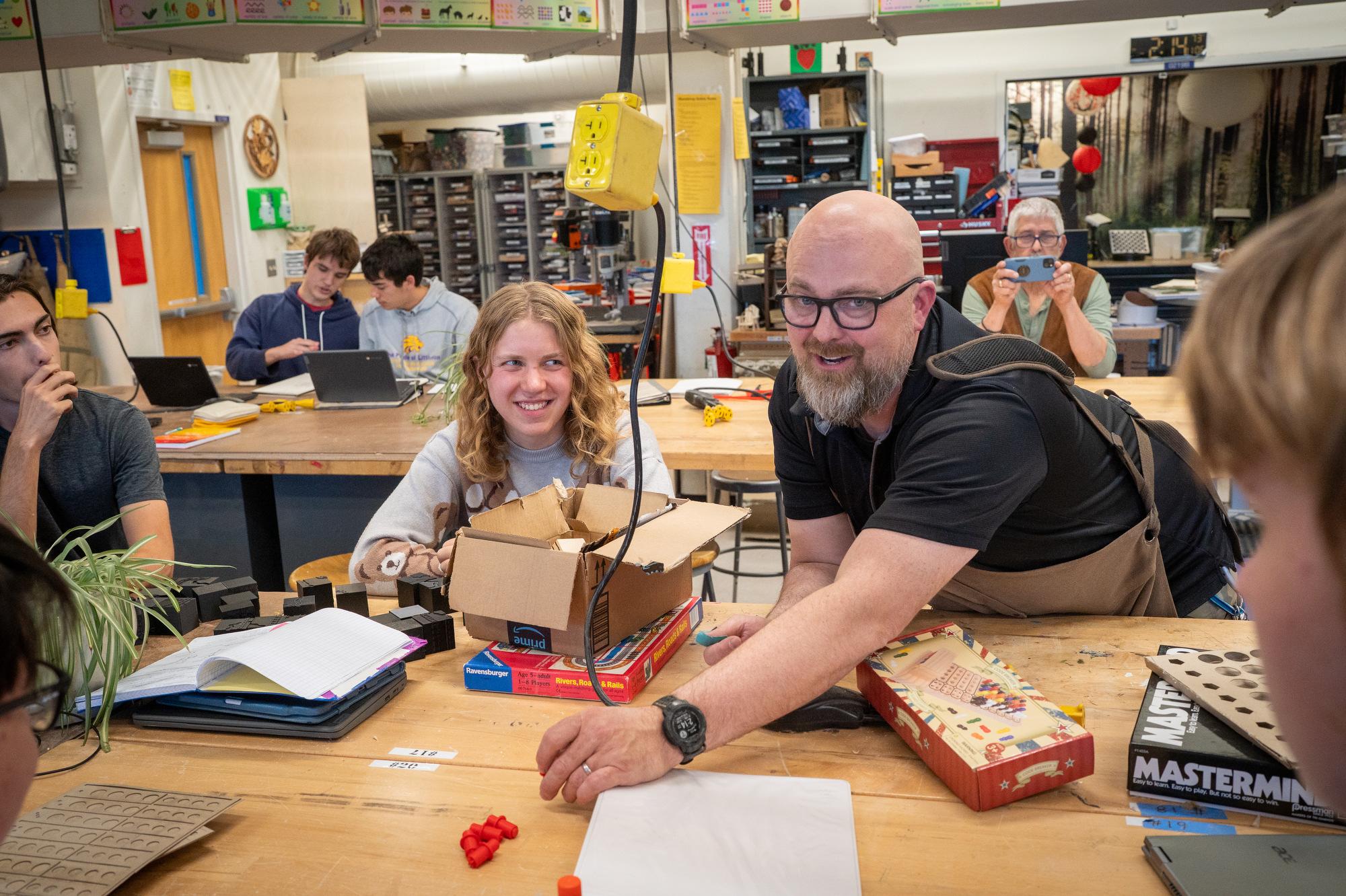
When you walk into Brian Jernigan’s high school Design Engineering class, you won’t see birdhouses or dog dishes like in an old woodshop class.
The Littleton High International Baccalaureate students are using laser cutters and 3D printers to solve real world problems — making a prototype for adaptive technologies.
The way 17-year-old Bea describes it is music to her teacher’s ears.
“This is the coolest project I've ever worked on,” she said.
Her team is redesigning the classic board game “Code Breakers.” Bea says it’s a real request from a client the American Printing House for the Blind.
“I get to work on something that is going to positively impact someone who needs it. Like, this isn't a fun project because my mom wanted a table. These kids can't have access to these resources because if any other company made this, it'd be $100.”
The school’s focus on empathy is validated by design experts, with the IB curriculum now listing empathy as its number one driver. Jernigan — the school’s woodworking and engineering instructor — uses the term, “empathy engineering,” a learning model where students are driven by the goal of helping others. And it’s not just applicable to these advanced students.
Jernigan said his introductory design students bring extraordinary empathy and creativity to projects that will help other people.
“The kids respond. You give them the tools and you give them the reason, and you give them some empathy around others in need, and you get out of their way,” he said.
“It gives them purpose. Look at the engagement. They feel like they get to make a difference.”
Hustling toward an industry deadline
Students in this workshop are developing everything from a planet-friendly satellite to a clip to hold up pants.
But the main project is the Code Breakers redesign — turning a game in which players try to deduce codes into something a visually impaired person can play. Students are working for far more than a grade. By the winter break, they must submit 10 prototypes to American Printing House for the Blind. That company will distribute them to schools for the blind nationwide for testing. Students will get feedback and then move into full production through local manufacturer Method Manufacturing. The product will be sold nationally.
Jernigan gives kids a few instructions and then: “It’s on you now. You got to get a product out the door. Divide and conquer. I’m here for you.”

Junior Andrew gets ready to cut another prototype game board on the CNC machine, a manufacturing tool that cuts precise shapes on many different types of materials. He uses the graphics editing and design program CorelDRAW.
“I just went ahead and made some adjustments to our design here ... hopefully we can get an even higher quality prototype than our other three.”
Jernigan has told them in the real world, time is money, so he can’t fiddle around.

Empathy drives engagement
Jernigan learned years ago that injecting empathy into projects is key for motivation. CU Boulder approached him with a federal grant to explore 3D printing for visually impaired children. The shift in his students was immediate.
“All of the sudden, 100 percent of the kids are giving me 100 percent. They all really tried, because ‘my time matters.’ That was the magic moment that I saw.’”
More than a decade later, Jernigan secured another grant to transform the old woodshop into a modern design lab: lasers, 3D scanners, high-end computers.

A student working on a Braille plaque for visually impaired English-language learners said the empathy focus makes them better designers.
“I think that the most important thing we can do as humans is care for one another so that's why this class is perfect, " said Mo, 17.
For a newcomer, the lab looks like controlled chaos
In the classic board game Code Breakers — the code that players are trying to guess is a sequence of colored pegs. Andrew, 16, explains that for visually impaired children, color won’t work.
“Our biggest focus is on making everything tactile… so they can discern all the different aspects of the game.”
They’re scaling up peg sizes, carving ridges into the board, numbering rows. The work is meticulous and the deadline looms. Students make most decisions themselves.

Everyone works on a piece of the puzzle. Some are at CNC machines; others sketch shapes for the game pieces. Kiley, 16, works as a de facto project manager — though she may not realize it. Massimo, 16, bustles around getting ideas for a second prototype in case the client doesn’t like the first. When he proposes distinctive designs on the sides and top of each peg, the group is skeptical.
“I don’t think we have that many unique shapes,” said Bea. “I think you’re overestimating how complicated I can make those.”
“Don't overengineer it…” said another student. They compromise. When something doesn’t work, they pivot fast — just like industry.
American Printing House is excited to help teach future workers to make accessibility part of every job.
“So these kids, what they’re getting is an opportunity to put something on their resume that’s real, relevant, and will be for the rest of their lives,” said Jernigan.
Design — with purpose
But the board game isn’t the only accessible project. Others are designing personal innovations.
- an environmentally-friendly satellite made from wood that burns up cleanly on re-entry
- a redesign of the old children’s game, “Rivers, Roads, and Rails.”
- a camouflaged climate monitor for endangered pika habitats.
- a clip for pants that are perennially too long for shorter people so they don’t have to hem them.
- a protective box with a "salt maintenance system" to keep seedlings from dying.
A Littleton High speech therapist asked for a teaching aid for speech-device users. Neo, 17, designed 96 color‑coded “core word” blocks.

“This is a product that definitely could turn into money [but] I don't care about that,” said Neo. “The fact that it's going to make an impact nationwide, that's… something you get to carry with you.”
After teaching basic skills, Jernigan steps back.
“It's not easy, it's not black and white, it's not, ‘Hey, how do I get an A on the test?’ It's dirty, it's messy, it takes time. There are failures, there are setbacks, and, you know, that's life,” he laughs. “And then we pile a little bit of empathy on it and it just, you know, it fuels them and it fuels me.”

Empathy engineering is for everyone, not just IB students
Jernigan recently launched a new unit in his introductory industrial design course, Elements of Design. Students range from grades 8–12 with diverse abilities and goals. They aren’t necessarily pursuing design engineering, they’re here to create and find meaning.
“They are…the other 90 percent who may not see themselves as high achievers, yet bring extraordinary empathy and creativity,” said Jernigan.
Both classes design for individuals who are blind or visually impaired. The IB students approach it analytically; the Elements students through a tactile, craft-based lens. They work with real product needs from the Anchor Center for Blind Children. Seventy-five of those students just delivered products to the school.
“There’s something genuinely magical about this group,” Jernigan said. “Without the pressure of test scores or college admissions….their focus shifts entirely to empathy and creativity.”