
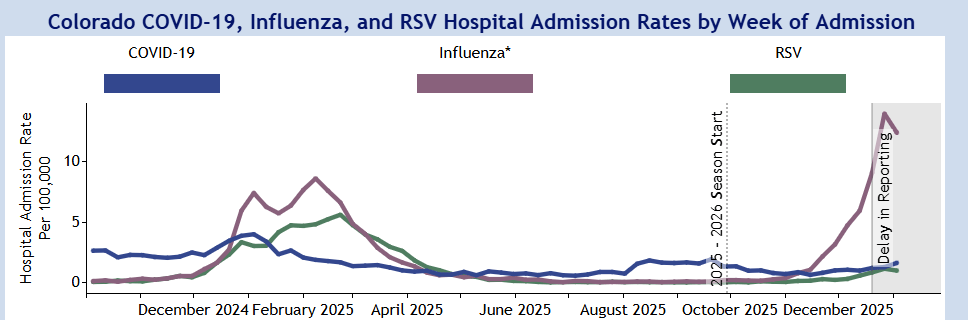
Hospitals remain extremely busy with influenza patients, even as the wave of illnesses in Colorado ebbed a bit. Nearly 740 Coloradans were hospitalized with flu for the week ending Jan. 3, according to the latest data posted Wednesday from the Colorado Department of Public Health and Environment.
Two days after Christmas, Colorado hit a record 831 people hospitalized with flu, the most since the state began tracking it two decades ago.
Other metrics improved a bit as well, despite still being at very high levels.
The number of tests coming back positive, also called the weekly sentinel positivity rate, is about 25 percent, a drop of about 8 percent from last week. The share of emergency department visits in which flu was diagnosed dropped to about 7 percent, down 2 percent from a week ago.
Still, all of the 21 utilities monitoring for flu in wastewater detected it, which likely means the wave isn’t over.
Infectious diseases pediatrician Dr. Suchitra Rao said 400 patients a week are testing positive for flu at Children's Hospital Colorado in Aurora. It admitted more than 500 kids with flu this season, which she called "staggering given the fact that we're potentially not even in the, the middle or the peak of the, of the season. We're nowhere near the end of the season."
It's the same picture at UCHealth LoneTree Primary Care, where Dr. Jennifer Corliss is the medical director. She said health systems learned a lot from COVID about managing increased volumes, but “that can be a significant strain on the hospitals as well as the outpatient clinics. Just managing these patients and having enough room for them and enough staffing is always a concern.”
Experts are also watching other respiratory virus trends. Levels of COVID-19 and RSV are creeping up slightly, but are far below the metrics for flu.
A spokesperson for the state health department said Colorado continues to have a high level of influenza activity.
“The cumulative number of hospitalizations this season is now over 3,000, at a rate of 54.3 hospitalizations per 100,000 people,” said Hope Shuler. “The hospitalization rate for the week ending Jan. 3, 2026, is 12.4 per 100,000, which is 1.6 times higher than last season at this time.”
While there was a decline in hospitalizations last week compared to the previous week, that may be due to people not seeking health care, as well as a reporting lag, around the holidays.
“Therefore, it is too early to determine if we have reached the peak of flu activity,” Shuler said. “Flu season can last into May, so it’s not too late to get your flu vaccine.”
Why is this flu season hitting hard?
Several factors for the flu spike include a new, rapidly circulating Influenza A variant. And lower vaccination rates. Just about 28 percent of the state's population have gotten a flu shot. That’s lower than other recent seasons, though the gap is closing a bit as more Coloradans are getting vaccinated now.
Vaccinations for some demographics remained much lower than health experts and doctors would like to see. About 8 percent of Hispanics and 19 percent of Black Coloradans have gotten a flu shot. Just half of those 65 and older, who are among the most vulnerable, have gotten it; with 30 percent of young people 6 months to 9 years and 21 percent of those aged 10-19.
Also, some rural counties in the plains and north and west of the state all have vaccination rates below 20 percent.
Health officials said more vaccinations would keep more people from getting seriously ill.
“If we saw higher levels of vaccination, I do believe we would have fewer hospitalizations occurring,” said Dr. Rachel Herlihy, the state epidemiologist.
The dominant circulating strain is a new Influenza A(H3N2) virus subclade, dubbed "Subclade K." It emerged in mid-2025. It’s caused a national surge in cases, according to the federal Centers for Disease Control and Prevention.
The variant emerged after health bodies had already selected for the strain that was circulating at the time, leading to a partial mismatch in the flu shots given out this fall and winter. Still, Herlihy said getting immunized provides significant protection against severe illness, hospitalization and death.
“Vaccines really continue to be our best protection against viral infections, including influenza, RSV and COVID-19,” said Herlihy, who encouraged people to get up to date on those vaccines if they're not already.
She had one other key piece of advice. Stay home if you're sick, so you don't get anyone else sick.
The surge comes as the Trump administration reduces the number of vaccines routinely recommended, including flu
The CDC said this week it was cutting back the number of vaccines routinely recommended for all children from 17 to 11.
Health and Human Services Secretary Robert F. Kennedy Jr. has for years questioned the safety and effectiveness of vaccines. President Trump last year pushed for changes in vaccinations.
Vaccines under the new schedule that had been recommended for all children previously — like those for seasonal flu and also for hepatitis A and B, meningitis and rotavirus — are now more limited, only recommended for those at high risk or after consulting with a health care provider, a practice called "shared decision-making."
Major medical groups, like the American Academy of Pediatrics, have blasted the move, calling it “dangerous and unnecessary.”
“Downplaying influenza vaccination recommendations is a huge problem given that we had our most severe flu season in many years for children last year,” said Dr. Sean O’Leary, a Colorado pediatrician and chair of the Committee on Infectious Diseases for the American Academy of Pediatrics. “And this year is looking to be a pretty severe flu season, so it makes zero sense to be backing off on influenza vaccine recommendations at this point.”