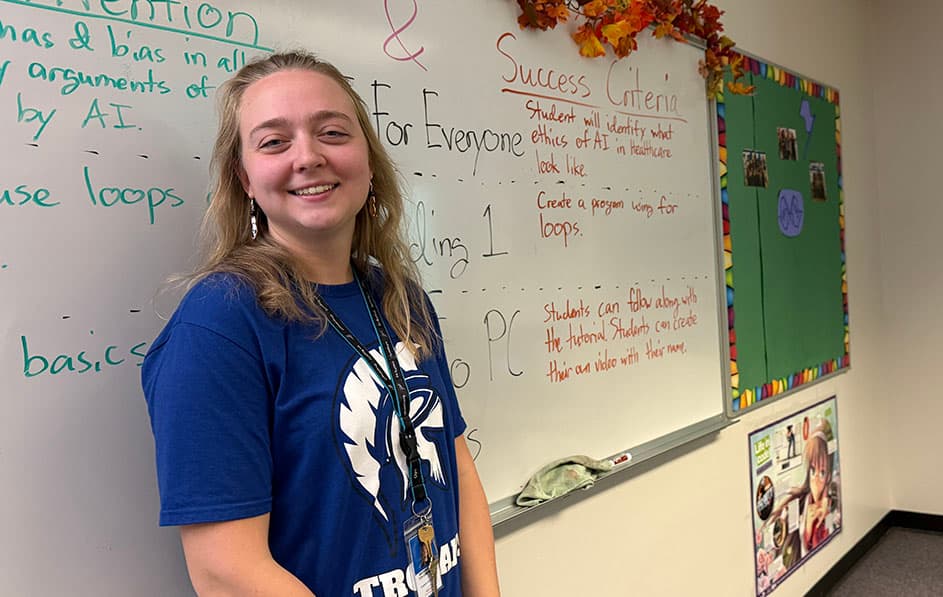
Thornton High School computer science teacher Melissa Borfitz, 24, is in her planning period. She’s sitting next to another teacher — sort of — named Edthena.
Edthena is actually an artificial intelligence instructional “coach.” It guides teachers through self-reflection to improve skills like classroom management or student engagement. Unlike traditional evaluations, the AI coach offers a "low-stakes" environment where the only audience is the teacher herself.
The software has already scanned a video 24-year-old Borfitz recorded and uploaded of her “Intro to PC Apps” class. For Borfitz, a third-year teacher still honing her craft, the tool offers private, objective reflection.
The chatbot asks Borfitz for skills she wants to work on. She types in her answer. She wants students to figure out things on their own, rather than follow her step-by-step instructions for video editing. The AI analyzes the recording, provides time stamps, and prompts her with questions like “What might you do differently next time?”
Borfitz watches the video of her teaching.
“I wish I had done more questioning that would have made them think for themselves a little bit more,” she muses, looking at the screen.
As districts face teacher burnout and mentor shortages, some are turning to AI to fill the gap. The tools let teachers reflect on their own time and may free up human coaches for deeper instructional work. But the platform has limitations. It can’t replicate nuanced, relationship-based coaching. Still, at least two Colorado school districts say it’s designed to be a supplement and is helping them accelerate the training process.
“It does not replace what our human coaches are doing”
The Adams 12 Five Star School District is in the first year of a three-year pilot using Edthena. New teachers like Borfitz are required to use the AI tool twice a year at a time of their choosing.
Rebecca Bergstrom, the district’s induction coordinator, said Edthena is designed to help teachers engage in some of the most important practices for becoming a better teacher.
“That idea of self-observation and self-reflection, watching myself teach, and engaging in that reflective process.”
Human coaching is labor-intensive, often requires multiple appointments and complex scheduling – and coaches are stretched thin. As a result, many teachers only receive formal feedback once or twice a year, often during a high-stakes evaluation. The AI coach promises a "low-stakes" alternative.
“We don’t want a dog and pony show,” Bergstrom said. “We don’t want somebody creating something they don’t do day in and day out. That’s now what you want to get coaching.”
Because it’s a machine, Edthena doesn’t judge. It doesn’t report to administrators. It simply asks questions. But Bergstrom said it lacks the human ability to consult or collaborate.
“It really allows our coaches to come along at the right time, and say, ‘OK, so you selected this goal and you’re kind of thinking about it, going about it in this way, let me help you with that a little bit.’ ”
Research on the long-term effectiveness of AI coaching is still limited. But some research with adult learners shows feedback from AI prompted teachers to more regularly acknowledge student contributions and questions.
Costs for AI licenses run $1,980 annually for up to 20 teachers and $4,990 for up to 100 teachers, according to Edthena.
Human nuance or machine prompting?
An EdWeek Research Center survey in late 2024 showed more than half of teachers felt comfortable with AI-assisted coaching.
So, which does Borfitz prefer — a human coach or Edthena?
“Oh, that's tricky,” she laughs. “The really nice thing about this AI coach is that when I take a video of myself, only I get to watch it and so, it's very private and that makes me a lot less nervous about teaching in front of someone.”
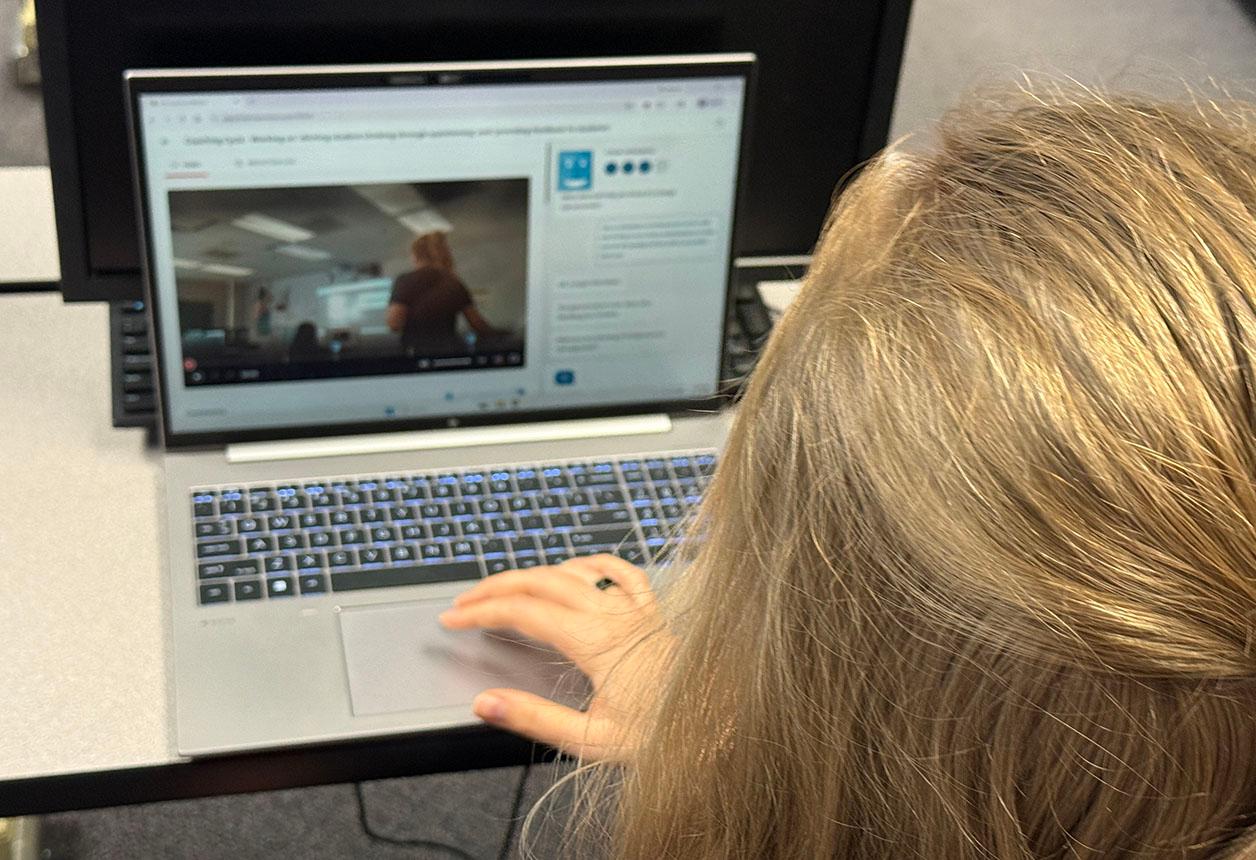
She can reflect when she wants and see her classroom as it actually is.
“Just having a video where just I'm reflecting is really nice and takes that extra pressure off.”
She’s become more aware of how much students talk, how engaged they are, and how long she pauses after questions. Borfitz learned that she tended to circulate on one side of the class — causing students to sit on the other side. She’s changed that. The video also confirmed she’s not speaking as fast as she thought she was.
“That’s pretty cool … I’ve gotten better at my job, woo-hoo!”
But AI coaching has limitations. It’s not offering deep pedagogical insight and can’t drive big instructional improvement on its own. Borfitz said a human coach would see more of what goes on in the classroom, like how she manages behavior while teaching and give her specific strategies.
Is AI feedback worth it when time is a precious commodity?
Cleveland Smith, who teaches seventh-grade English in the St. Vrain Valley District, is a tech-savvy early adopter who uses AI with students. But when he piloted the tool on his own teaching, his reaction was lukewarm.
“What I thought this new AI Athena model was …. going to evaluate my video.”
Like show him data on how many times a student was losing focus. It didn’t. Instead, it prompted self-reflection. He said time is the most precious commodity for teachers.
"For me, it didn’t seem like the tool was where I wanted it to be in order to make it worth my time," Smith said, adding that’s not Edthena’s fault. Smith said future AI with spatial intelligence may one day evaluate classroom video. He’d be eager to try it- but only for teachers’ private use.
Smith sometimes co-teaches and gets valuable feedback from colleagues.
“What makes a human coach wonderful is you can have a relationship with that person,” he said. “You might be able to leverage a human relationship in ways that you would never be able to with AI.”
Multiple ways to use Edthena
In the St. Vrain Valley School District, teachers rated as effective or highly effective can submit a report from an Edthena coaching session as part of their formal self-evaluation. Edthena has also helped teachers learn a new math curriculum and fulfill state literacy training requirements.
Surprising the district’s chief academic officer Diane Lauer, veteran teachers are the biggest users of Edthena, often as a way to try something completely different.

“They can take a lot more risks when it’s 100 percent private,” she said. “They're really able to use it as an imaginary friend, partner, coach.”
The benefits of teachers watching themselves on video are undisputed.
“Even when you have a human come in, they bring in their own bias,” she said. “You hear their feedback, but you don't see yourself teach.”
She said the tool can prime teachers for deeper conversations with human coaches.
A new plan for the classroom
As Borfitz works through her session with Edthena, the tool asks her to rate the lesson, reflect on strengths and patterns and set a goal and plan.
Borfitz settles on a goal: finding a better way to hold students accountable beyond circulating the room.
“Maybe I could do something where they have to screenshot or record each animation and then turn that in,” she said, like breaking up the final assignment into little sections.
Edthena: How can you measure this change?
Borfitz: “I know something has changed when I can see more students on task.”
She also plans to track how many students complete the final project.
Edthena: Why does achieving this goal matter to you?
Borfitz: “This goal matters to me and my students because I can make sure they understand the lesson better and are able to keep themselves accountable.”
Borfitz will test the idea in her next class then reflect again. She knows a human coach is still there if she needs one.