
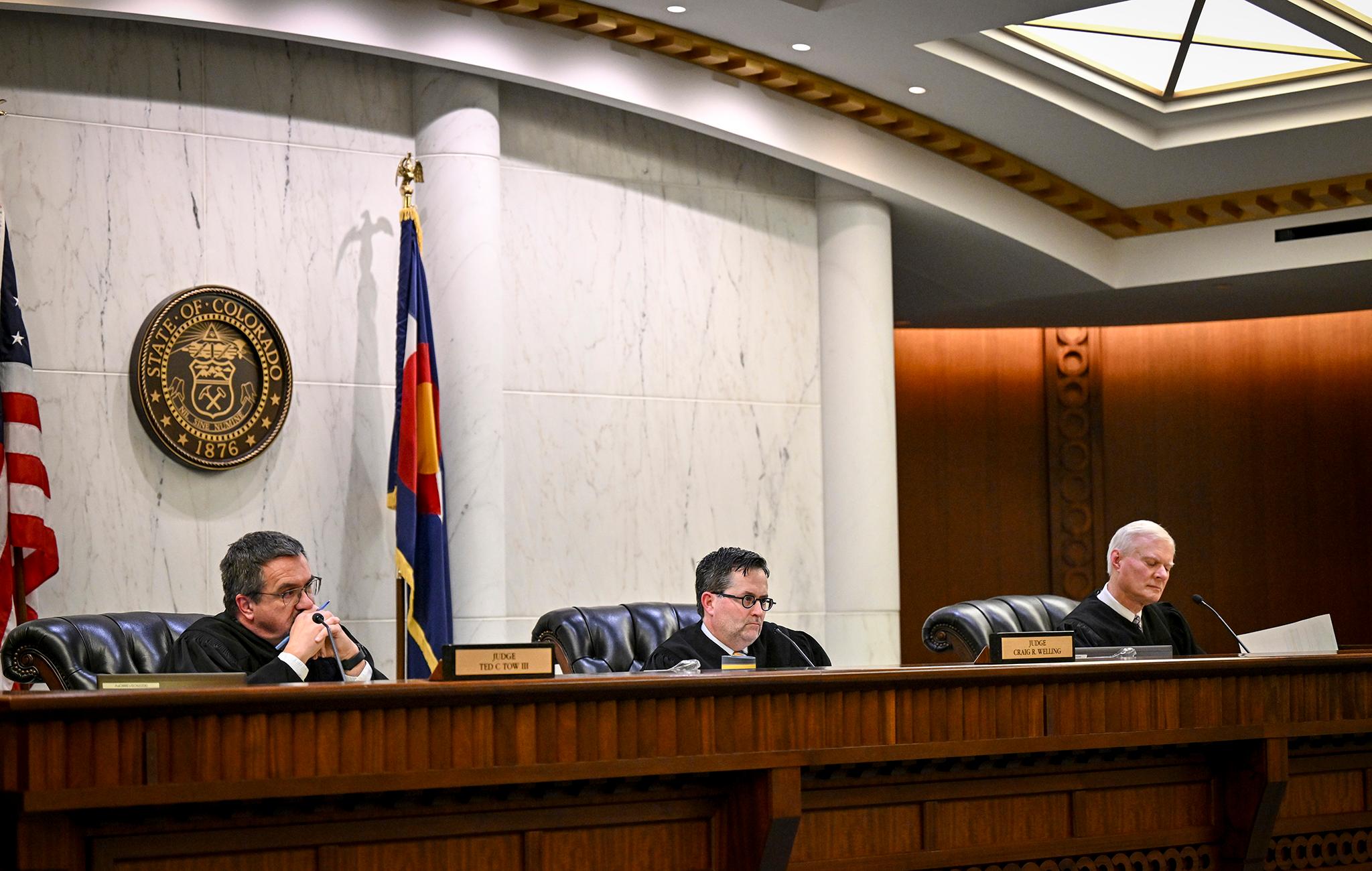
A panel of Colorado appellate judges scrutinized arguments as to what claims former Mesa County Clerk Tina Peters should have been able to make at trial in 2024, and whether or not a judge’s strong words for her suggested too harsh a sentence.
Attorneys for Peters and the Colorado Attorney General’s Office made oral arguments in front of three Colorado Court of Appeals judges on Wednesday. It’s the latest step by Peters’ legal team to free her. One of the central discussion points regarded whether Peters should have been allowed to make an affirmative defense case that she believed she was acting in an official capacity when she deceived public employees to allow unauthorized access to county voting equipment.
The key element of Peters’ conviction was that she misled state and county officials about the identity of a man named Conan Hayes. After creating a security credential under a different man’s name, Hayes was allowed to watch a software update of county voting equipment.
Judge Ted Tow grilled the state on if there was a contradiction in not allowing Peters to make that case given that one of the charges, a misdemeanor charge of official misconduct, required prosecutors to prove intent.
“The jury has to hear that evidence to be able to determine whether the prosecution proved the charge,” Tow said.
Lisa Michaels, senior assistant attorney general, argued that it’s not that Peters wasn’t allowed to make any case about her intent, just that it was limited. During the trial, prosecutors said it was necessary to limit Peters’ claims to avoid turning the trial into a debate over election conspiracies. Tow asked if that was prudent.
“When it comes to a defendant's constitutional right to present a complete defense, does a trial court have the ability to curtail that in the interests of not letting the sideshow overcome the circus?” Tow asked.
Michaels said “the danger of unfair prejudice, confusion of the issues or misleading the jury substantially outweighs any probative value.”
At the same time, judges also probed Tina’s defense team, led by John Case, over their claims that it was necessary for Peters to mislead officials over who Conan Hayes was.
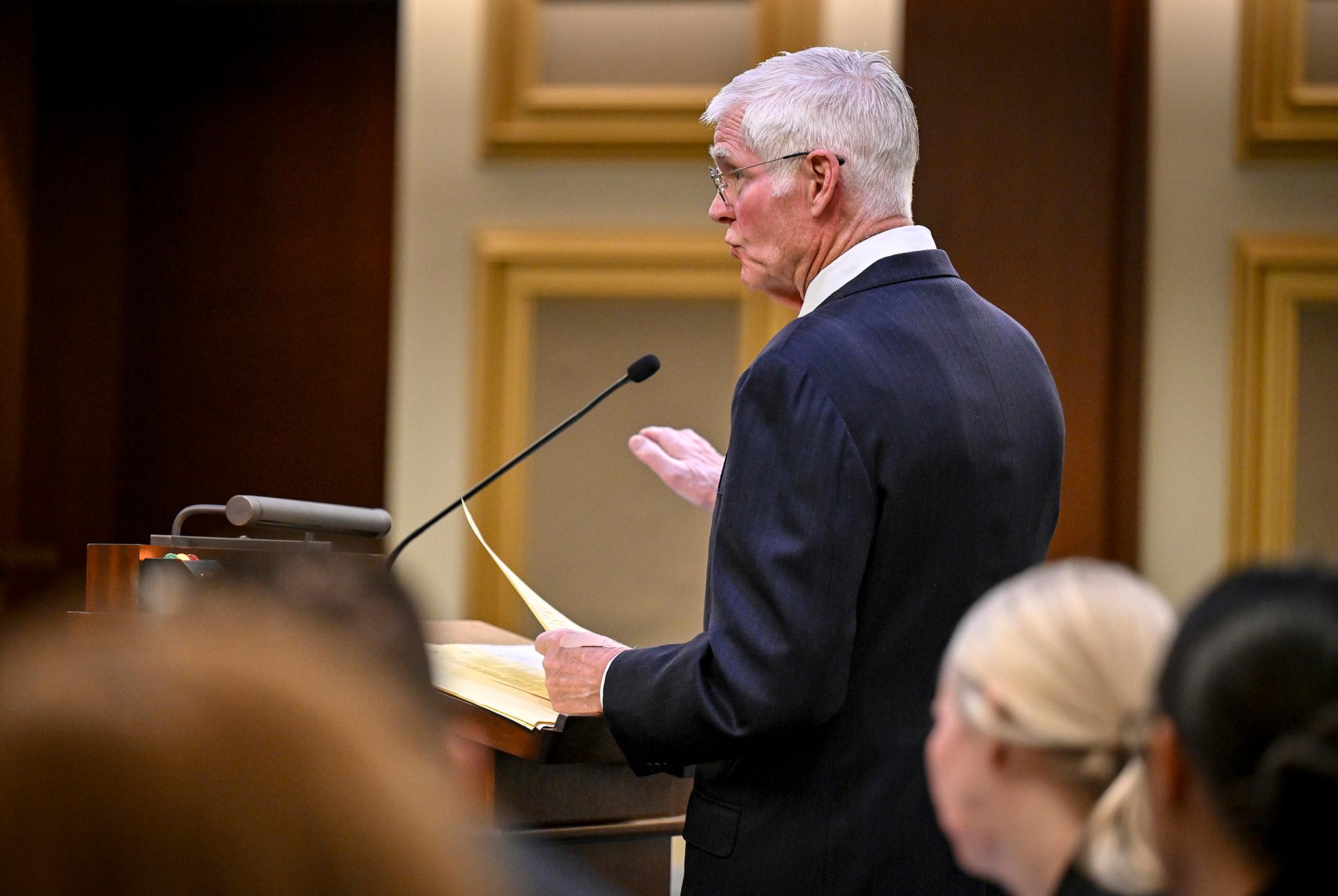
Tow asked Case why Peters didn’t just say Hayes was authorized to be there “instead of saying, ‘Oh, no, no, this is a county employee’ and lying about who he was.”
“Because if the trusted build (software update) doesn’t go down, then she can’t conduct the elections. That’s her understanding. And then the machines will have to go to Denver and she won’t be able to see what happened to them,” Case responded.
“So, in other words, she wanted to trick the Secretary of State into going forward?” Tow asked.
Sentencing issues
Judges also raised concerns that Peters’ sentence — more than 8 years in the Colorado Department of Corrections — was harsh in a way that infringed on her First Amendment rights. Judges zeroed in on language at the sentencing by 21st Judicial District Court Judge Matthew Barrett wherein he called her a “charlatan” and said she was peddling “snake oil.”
Judge Craig Welling questioned why Peters was barred from making arguments about the election during trial but those claims were brought up during sentencing.
“My concern is that it did substantially inform the sentence that was imposed, and that creates some constitutional problems. And you don't get to ride both horses,” Welling said.
Michaels responded by noting that, ahead of sentencing, Peters presented a lengthy slide show that demonstrated she was still defiant in her actions and it then made it fair game for the judge to consider those actions. Welling was dubious that Judge Barrett had sufficiently set apart his critiques of Peters’ language from the sentence he was imposing.
“My concern is that the court didn't say that she's engaging in all of these hoaxes and she's undermining public confidence and she's doing all of these things that I think are very detrimental to society. But I'm not considering those for purposes of the sentence,” Welling said.
Michaels responded, saying the court transcripts suggested a clear delineation from the reasoning for imposing her sentence and the comments about her public statements. .
Case, when asked about sentencing, did request that if the case were ordered to be re-sentenced that another judge should do so.
Jury instruction issues over felony charge
The appeals court judges did voice concerns over a claim that Peters’ attorneys argued that the language over one of the charges, criminal impersonation, was improper and confused a felony charge with a misdemeanor one.
Specifically, the issue is over the use of the word “might” as it relates to whether or not the criminal impersonation could have subjected someone to liability. Based on the charges and jury instructions, the crime should have been considered a misdemeanor but the state has argued the evidence presented could have proven a felony charge.
“I'm confused as to why the people are continuing to maintain that the proper remedy on this isn't to enter the conviction for the misdemeanor because the indictment used the word ‘might’ and the jury was instructed on that,” Welling said, adding “I am baffled as to the position that's being taken that we can somehow overlook that and still enter the felony because the evidence that was presented at trial would've supported the felony.”
Immunity claims
One of Peters’ claims on appeal is that, in acting to preserve election records, she had immunity from state prosecution via the supremacy clause, which protects federal officials from prosecution at the state level for trying to carry out official duties.
The Court of Appeals judges raised questions as to whether there was any scenario wherein the state would acknowledge that Peters might have an immunity claim. At the same time, they seemed skeptical of Case’s argument that Peters needed to deceive a public official in order to carry out her official duties.
“If she just executed a duty, but didn’t commit a crime, we wouldn’t be here,” Welling said, asking Case where the authority to investigate the county’s voting equipment came from.
“I think it extends to finding out what's going to happen during the so-called trusted bill (software update), which turned out to be a wipe,” Case said.
Peters’ legal team has made several claims that, because of her immunity argument, the Colorado courts do not have the jurisdiction over the case. That prompted some confusion over how the court of appeals should move forward because if the appeals court did not have jurisdiction then it wasn’t in a place to overturn the lower court’s ruling.
“I'm not sure you really want what you're asking. For us to decline to exercise jurisdiction, then the conviction stays,” Welling said.
Pass on pardon question
The supremacy clause question, and whether or not it afforded Peters immunity, is not the only jurisdictional question raised by Peters attorneys. On Christmas Eve, Peters’ attorneys asked the Court of Appeals to rule if they still had jurisdiction given a pardon issued by President Donald Trump. Attorneys for Peters contend that the pardon power can be read to apply to state laws, something most legal experts disagree with.
Judges did not hear oral arguments on the pardon question Wednesday, and said they would issue a written ruling on the rest of the questions in due time.
- Mis-applied law, immunity claims and Samuel Clemens’ nom de plume: Here’s what might come up at Tina Peters’ appeal hearing Wednesday
- Governor Polis calls Tina Peters’ prison sentence ‘harsh,’ renewing clemency conversation
- Trump claims to have ‘pardoned’ imprisoned Mesa clerk Tina Peters
- Tina Peters is not a bargaining chip and other takeaways from a live interview with Gov. Jared Polis