Updated at 5:56 p.m. on Thursday, Jan. 29, 2026.
Colorado will participate in a first-of-its-kind federal tax credit voucher program that could help fund private education.
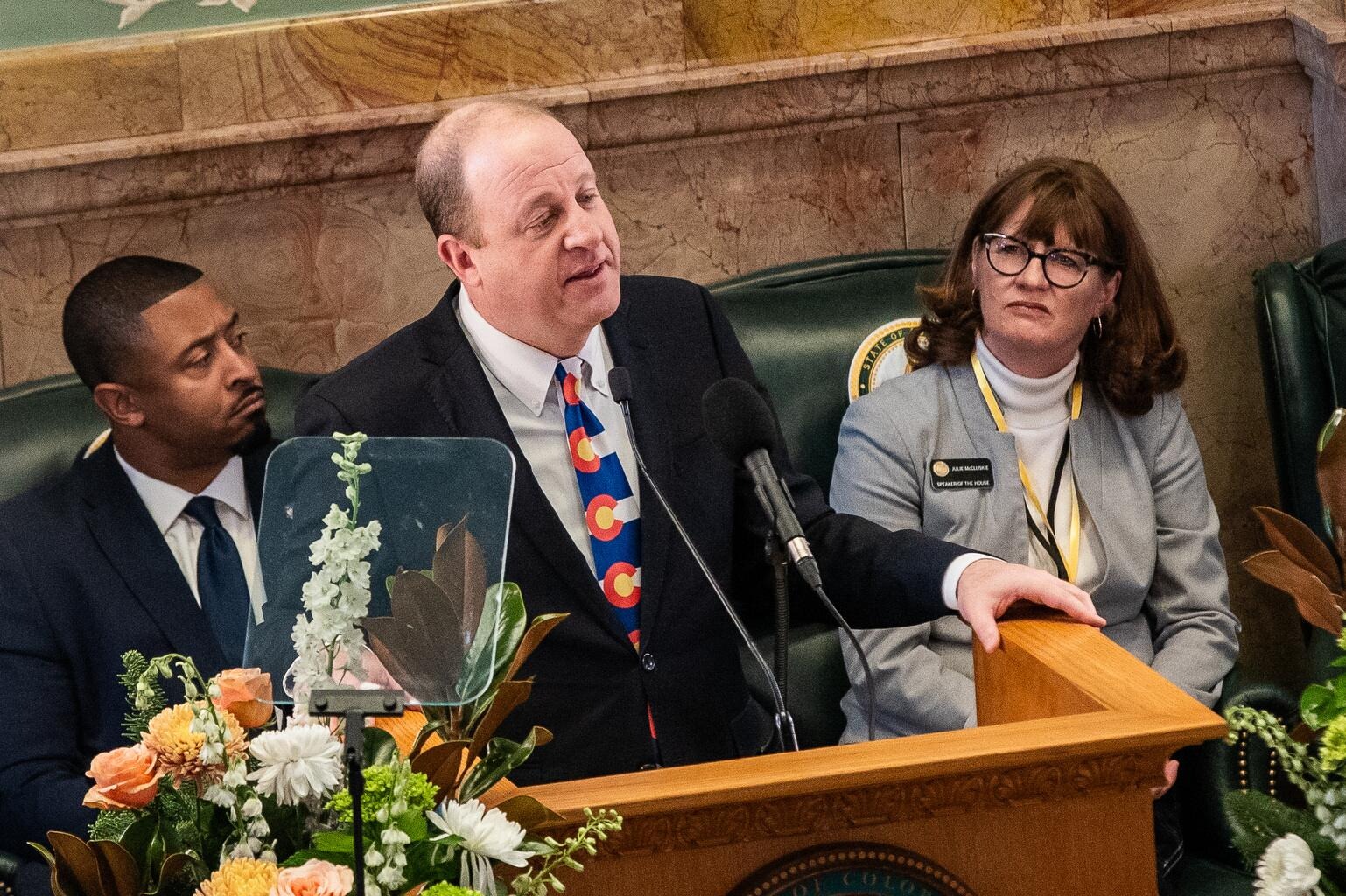
Gov. Jared Polis made the announcement at a gathering of private and religious school choice advocates Thursday, as he simultaneously lobbies the federal government for stricter oversight to prevent the program from devolving into "fraud, waste, and abuse."
The program, established under the federal "One Big Beautiful Bill," offers a 100 percent federal tax credit — up to $1,700 annually — for donations made to Scholarship Granting Organizations, or SGOs. Families could then take advantage of the scholarships.
While religious and other school-choice advocates applauded the announcement, a coalition of public-school advocates in Colorado have voiced strong opposition to participating in the program. And Polis’ written comments to the IRS reveal a deep-seated concern that the federal government’s draft rules may strip states of their ability to regulate the program.
The Treasury Department is currently writing rules for the program, which will start in 2027.
At Thursday’s event, Polis framed participating in the program as a pragmatic win for students that will provide additional resources for tuition, tutoring to address learning loss, special needs services, or education technology, among other uses.
“Really, it's only our own creativity that can hold us back,” he said. “Anything we can envision, this is a very powerful funding mechanism.”
He said if states don’t opt in, taxpayers can still donate, but residents of that state won’t be able to be beneficiaries.
Polis concerns
In several pages of written comments to the IRS in December, Polis outlined his concerns about “rote application” of federal conditions on the scholarship-granting organization could provide a roadmap for abuse. He asked for several revisions.
"Without careful consideration of how states select and monitor their eligible SGOs, this credit also has the potential to lead to fraud, waste, and abuse," Polis wrote.
He asked for states to have the power to oversee eligible organizations, broad flexibility in how funds can be used, and let states define what counts as a school and several clarifications that scholarships can cover things like summer programs, college classes for high school students, and support for four-day school weeks.
Specifically, he urged the Treasury Department to allow governors to retain "discretion and oversight" over which SGOs are eligible.
"There must be a way that a state can act if a scholarship is funding kids to attend a school that is condemned because the roof is about to collapse."
In the letter, he stated that Colorado intends to opt in but asked the Treasury to finalize guidance early this year so states can determine which organizations are eligible in time for the 2027 tax year.
The governor’s office said in a statement that Thursday’s decision to opt in ensures donations can help children in Colorado instead of other states.
“We will be carefully reviewing the Treasury’s rules when released before submitting a list of eligible Scholarship Granting Organizations from the state.”
Religious and private schools see a way to educate more students in need
For leaders of Colorado’s private and religious schools, the governor’s decision is a long-awaited victory.
Natasha Harris, co-founder of the Colorado Christian Academy in Denver, said the financial gap often prevents low-income families from accessing private education. Twenty percent of their population gets tuition assistance.
"As a private school, we witness the demand for school choice," said Harris, who spoke at the Invest in Education event. "There's a gap between the private tuition, the tuition assistance schools can afford to pay, and what the family can afford to contribute. Gratefully, ACE Scholarships has been a partner with us ... providing that extra hand up".
Many Colorado private schools use scholarships provided by ACE Scholarship, a Denver-based nonprofit organization that provides partial, need-based scholarships for K-12 students from low-income families to attend private schools. It hopes to greatly increase the number of students it can assist under the new federal law.
Seeds of Hope, which provides needs-based scholarship to low-income families for a Catholic education, also hopes to benefit from the federal tax credit. Tricia Sullivan, the organization’s executive director, said it said will help more families break out of cycles of poverty. She said an independent study found their students exit their Catholic schools with higher GPAs than traditional public schools.
“The kids are coming out well educated and well formed…it's beautiful to send a kid to a Catholic school and know that they come out full of their faith.”
Critics warn program could ‘dismantle’ public education
On Wednesday, a coalition of public education advocates held a separate national press conference to urge governors to reject what they termed a "Trump school voucher tax scheme" that would divert public dollars to private schools and undermine public education nationwide.
Dawn Fritz, representing the Colorado PTA, said voucher-style tax credit programs often don’t protect students’ rights.
“Voucher systems usually lack accountability,” said Fritz. “They deprive students of the rights and protections they would receive in public schools, and they fail in providing adequate services for students most in need, including students with disabilities, low-income students, and students who are English language learners.”
Colorado voters have rejected previous private school choice proposals three times.
“We have defeated them at the ballot box,” she said. “We have defeated them at the state legislature. We need our governor to stand with us to defeat vouchers once again.”
Oversight concerns
After conversations with U.S. Treasury staff about the rules, others share the governor’s concerns that the current draft rules would leave states powerless to protect students or taxpayers.
"It seems very likely that the regulations will preclude individual states from engaging in any kind of regulation or oversight — either over the Scholarship Giving Organizations or the organizations receiving the voucher funding,” said Lisa Weil, executive director of Great Education Colorado. "Unfortunately, this is tax policy, not education policy."
Governors may be limited to passing on a list of SGOs that meet basic requirements, according to the IRS’s initial interpretation of the law.
“The opportunities for discrimination and fraud are rife,” Weil said.
At Wednesday’s national press conference, Damaris Allen, with Families for Strong Public Schools and a parent of Florida public school students, spoke of millions of dollars in unaccountable spending in Florida's program, vouchers being used at “unaccredited private schools,” and students with disabilities waiving federal protections.
An auditor’s report found that the program paid for 30,000 students that the state can’t accurately track, and showed widespread instances where students were simultaneously enrolled in public schools while their families received private scholarship funds.
“Our homeschool students have used taxpayer-funded vouchers to purchase lavish vacations, do crazy things like use taxpayer dollars to have an RV, drive across this country, and take trips, buy paddle boards, Disney tickets, TVs, and even patio furniture."
At least 30 states have decided to opt into the program.
Editor's note: This article was updated after confirmation that the state did opt in.