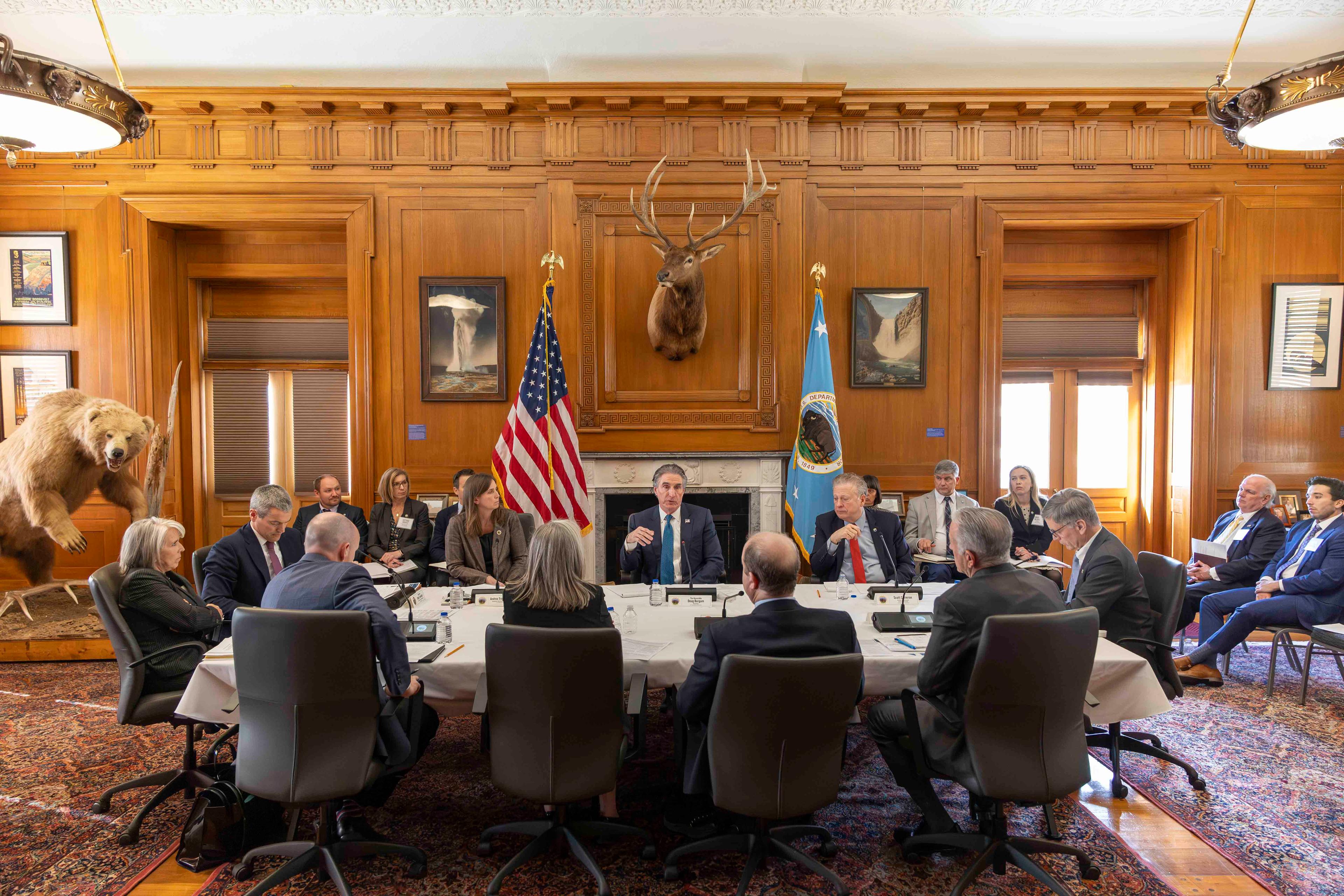
Governor Jared Polis expressed optimism about Colorado River talks after a key meeting with federal officials on Friday, while Colorado Attorney General Phil Weiser said this week that the state wouldn’t back away from legal fights to resolve water disputes.
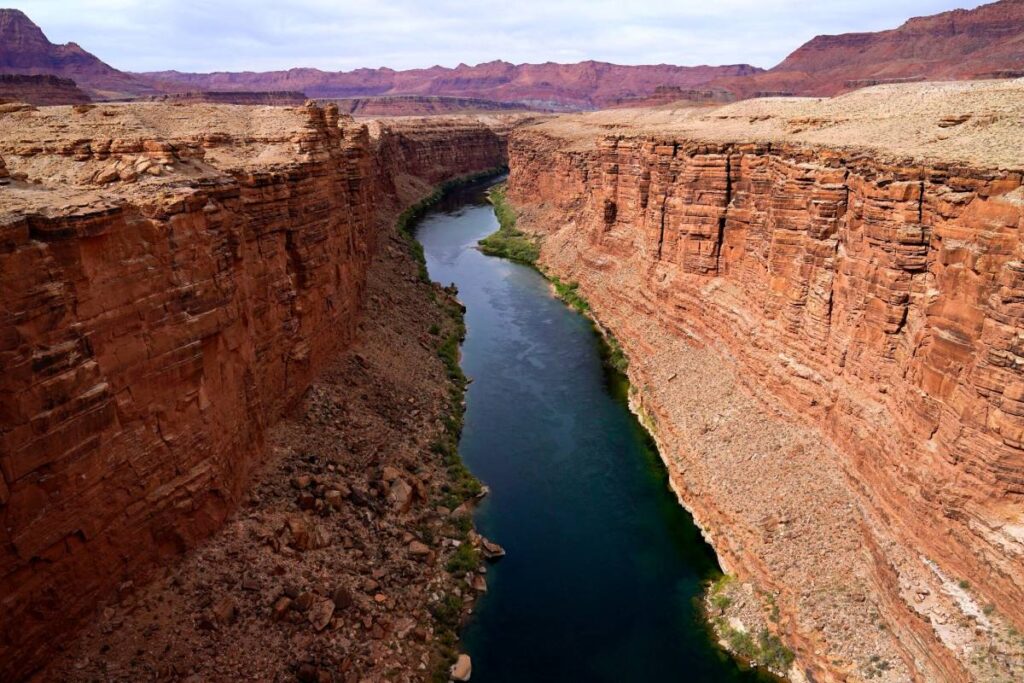
The seven Colorado River Basin states are locked in negotiations over the future of the river, which collectively provides drinking and irrigation water to millions of people.
The Department of the Interior summoned Western governors and state negotiators to Washington D.C. Friday to try to break the logjam around the multistate negotiations. Only California Gov. Gavin Newsom was unable to attend.
After the meeting, Gov. Polis told CPR News that the states were closer to a framework which could stave off years of legal pain.
“We all know that years of litigation and uncertainty hurts the ability of the West to succeed in important enterprises ranging from data centers to agriculture to oil and gas, all of which are important water users,” he said.
The DOI has said it will take over river management if the parties fail to agree on a framework.
“This is one of the toughest challenges facing the West,” said DOI Secretary Doug Burgum in a statement. “The Department remains hopeful that, by working together, the seven basin governors can help deliver a durable path forward.”
Polis said the key to any agreement was whether states could agree to adapt their water usage depending on annual supplies in the Colorado River.
“It’s tougher in the dry years to figure it out, but we need a framework that can get us through those as well,” Polis said. And so far, 2026 is likely to be an exceptionally dry year.
Weiser, speaking at the Colorado Water Congress’ annual convention on Wednesday, said that if states can’t reach an agreement, or if they find issue with the federal government’s approach, then a dispute could end up at the Supreme Court.
“We can’t be afraid of the possibility that we need to defend our rights,” Weiser said. “And if it comes to that, Colorado is not going to be a sucker.”
But Weiser stressed that the state’s preferred option is a negotiated one.
“Obviously, the best outcome is one where we do work together and find a sustainable solution,” he said.
A source familiar with the discussions added that six of the seven states are close to a framework, with Arizona as the outlier, and that the meeting helped attendees understand constraints on Upper Basin states.
Colorado River deadline looms
The seven states that make up the Colorado River Basin are separated into two camps: the Upper Basin, which includes Colorado, Utah, Wyoming and New Mexico, and the Lower Basin, which includes California, Arizona and Nevada.
Current guidelines for the river’s largest reservoirs — Lake Mead and Lake Powell — lapse this year, and states have until Feb. 14 to hash out an agreement.
Both sides are grappling over how much water each side should cut. The Upper Basin has historically used less water, while the Lower Basin is already subject to water cuts.
Although negotiators have failed to reach a consensus for years, those discussions are increasingly urgent. Colorado is experiencing record-low snowpack, while Lake Mead and Lake Powell have seen dwindling water levels, threatening supplies to states like California and Arizona.
Without an agreement, the federal government will impose its own options, which could be painful for states.
“The federal government makes plain what we all know,” Weiser said of the federal options. “It would be best if we could get a seven-state solution.”
Weiser said his office has a deep bench of lawyers and is “working hand in glove” with the state’s negotiating team. He also criticized the Lower Basin’s approach at times, saying that their positions may be untenable.
Finding a solution “takes two sides,” Weiser said. “And if one side is living in la la land, that’s not gonna happen.”
The DOI did not address whether the February deadline may be extended.
From Canal to Supreme Court
At the water conference, Weiser also provided updates on two other long-term water disputes.
The South Platte River starts in Colorado and snakes its way through Nebraska. A 1923 agreement governs how both states share water from the River.
That agreement allows Nebraska to divert a certain amount of water into a canal, which hasn’t been built yet. Last summer, the state sued Colorado and accused it of obstructing efforts to build that canal.
In October, Colorado urged the Supreme Court to reject the case, and denied that it was preventing Nebraska from building its canal. Weiser said that Colorado had been working with Nebraska and was surprised by the lawsuit.
The state believes that Nebraska may be trying to renegotiate the 1923 agreement through a lawsuit.
“To the extent Nebraska’s trying to use litigation opportunistically to get an advantage…that they don’t have based on the law, we’re not gonna give it to them,” Weiser said.
He added that he hoped the Supreme Court would reject the case, and that the states could continue working together.
Rio Grande dispute
The Rio Grande stretches from the San Luis Valley to the Gulf of Mexico. A 1938 agreement governs how Colorado, New Mexico and Texas share water from the River.
In 2013, Texas sued New Mexico and alleged that wells in the state were diverting water owed to Texas. Colorado and the federal government are also part of the case.
In 2022, the Supreme Court rejected a settlement that the states had reached, because the federal government had not signed onto it. But last year, all parties agreed to a settlement, which is under review by a “special master,” or an appointed expert who’s handling the proceeding.
Weiser said that process is basically at the finish line, and that the special master should recommend dismissing the case.
“We are confident the resolution will not have any detrimental effect on Colorado’s rights,” he said.
CPR’s Caitlyn Kim contributed reporting.